

Skin · 23 July 2025 · 7 min read
How often should you use a Dermapen? Safe timelines

By Alayika Parvez
Owner, CoLaz Aesthetics Clinic
The short version
- • For general skin quality, most people space professional Dermapen sessions 4 to 6 weeks apart; for deeper concerns like acne scars, 6 to 8 weeks.
- • Your skin keeps laying down new collagen for months after a single session, so treating more often does not speed results and can irritate the skin.
- • A typical course is 3 to 6 sessions, with maintenance every few months once your skin is where you want it.
- • Wait longer if your skin is still red, peeling, broken out, or irritated, and never treat over active acne.
- • At CoLaz, a clinician sets your spacing at a free consultation based on your skin and your goal.
The short answer is that most people should have a professional Dermapen session every 4 to 6 weeks for general skin quality, and every 6 to 8 weeks for deeper concerns like acne scars, because your skin needs that time to heal and build fresh collagen between treatments.
Doing it more often does not get you there faster. A Dermapen is a professional microneedling pen, and microneedling works by making tiny, controlled injuries that switch on your skin’s repair pathway. If you treat again before that repair has finished, you interrupt the very process you are paying for, and you raise the risk of irritation and uneven results. Below is how to time it properly, by skin goal, and when to wait longer.
TL;DR
- For general skin quality, most people space professional Dermapen sessions 4 to 6 weeks apart; for deeper concerns like acne scars, 6 to 8 weeks.
- Your skin keeps laying down new collagen for months after a single session, so treating more often does not speed results and can irritate the skin.
- A typical course is 3 to 6 sessions, with maintenance every few months once your skin is where you want it.
- Wait longer if your skin is still red, peeling, broken out, or irritated, and never treat over active acne.
- At CoLaz, a clinician sets your spacing at a free consultation based on your skin and your goal.
How often should you use a Dermapen?
For most skin concerns, a professional Dermapen session every 4 to 6 weeks is the standard spacing, with deeper work stretched to 6 to 8 weeks.
This is not a made-up number. UK guidance from the British College of Aesthetic Medicine describes microneedling as a course of “three to four treatments” with “approximately six weeks between them”, extending to up to six procedures for scarring. A wider dermatology review puts the safe range a little broader, noting that “treatments are performed at 3 to 8 week intervals and multiple sittings are needed to achieve the desired effect”. Four to six weeks sits comfortably in the middle of that window for everyday skin quality, which is why it is the spacing most reputable clinics use.
The exact gap depends on how deep the treatment went and what you are treating. Superficial work for tone and glow can sometimes be repeated a little sooner; deeper work for scarring needs longer. A trained clinician sets the interval for your skin, rather than you following a fixed calendar.
Why does the gap between Dermapen sessions matter?
The gap matters because collagen is slow to build, and your skin is still working long after the redness fades.
When the fine needles create their micro-channels, your skin reads them as small injuries and starts the wound-healing cascade, laying down new collagen, elastin and tiny blood vessels over the following weeks. The physiological mechanism behind this is well described in dermatology, and it is not a quick process. The same clinical review notes that “the final results cannot be viewed immediately because new collagen continues to be laid down for approximately 3 to 6 months after treatment”, and that a course of four sessions a month apart can show a large rise in collagen and elastin at six months.
That timeline is the whole reason spacing exists. If you treat again while the skin is still remodelling, you do not double the collagen; you interrupt healing, add irritation, and can leave the skin barrier weaker than when you started. More frequent is not more effective, it is just more inflamed. Letting each session finish its work is what turns a series of treatments into a real, cumulative improvement.
How often should you use a Dermapen for different skin concerns?
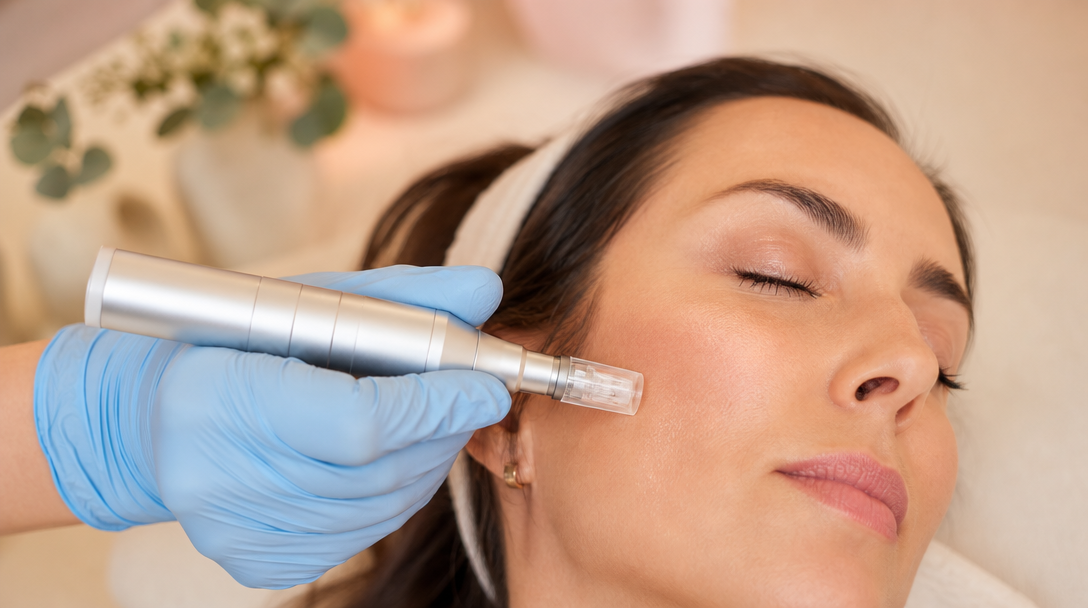
The right frequency depends on your goal, so here is a realistic guide by concern.
- General skin quality, tone and fine lines: every 4 to 6 weeks. This is enough time for the skin to renew and build collagen without over-treating, and it suits mild dullness, texture and early ageing.
- Acne scars and other deeper concerns: every 6 to 8 weeks. Scarred skin needs stronger, deeper treatment and a longer recovery between sessions. A systematic review of randomised controlled trials supports microneedling as a well-tolerated, effective option for atrophic acne scars, and the deeper the work, the more recovery time the skin needs.
- Stretch marks on the body: typically 6 to 8 weeks, as the skin here is treated at depth and heals more slowly than the face.
- Maintenance, once you are happy: every 3 to 6 months. Once your course is finished, occasional top-ups keep collagen production ticking over.
A broad dermatology review sets out the same picture: microneedling is used across scarring, fine lines, sun damage and stretch marks, and the protocol is adjusted to the concern rather than applied as one fixed schedule. If your main concern is acne scarring or stretch marks, expect the longer end of the range.
How many Dermapen sessions will you actually need?
Most people need a course of 3 to 6 sessions, not a single treatment, with the exact number set by your concern.
One session leaves the skin looking fresher, but lasting change comes from a series. The British College of Aesthetic Medicine suggests three to four treatments for general rejuvenation and up to six for scarring. That matches the trial evidence: the atrophic scar review found visible improvement in acne scars from as few as three sessions, with more sessions giving further gains on stubborn scars. An earlier review of applications reports similar course lengths across the different conditions microneedling is used for.
As a rough guide:
- Fine lines and general texture: around 3 to 4 sessions.
- Acne scars: often 4 to 6 sessions.
- Stretch marks: frequently at the higher end, 6 or more, because the skin is treated deeply.
Each session builds on the last, and your skin keeps improving for weeks after the final one as the collagen continues to form.
Signs you should wait longer between sessions
Even with a plan in place, your skin will tell you when it is not ready, and it is worth listening.
Book a little later, or check with your clinician first, if you notice any of the following:
- Skin still red or peeling. This means the barrier is still repairing. Treating over it can slow healing and irritate the skin further.
- An active breakout. Microneedling over inflamed acne can spread bacteria and make things worse. Wait until the area is calm.
- Ongoing stinging, burning or tightness. These are signs the skin is still sensitive from the last session and needs more recovery.
- A cold sore, or a history of them. Because microneedling breaks the skin surface, the American Academy of Dermatology lists a cold-sore flare-up and infection among the possible complications, so let your clinician know before you book.
Skin needs to be healthy before you treat it again. Microneedling is one of the regulated skin procedures the JCCP recognises in the UK precisely because it breaks the skin barrier, so a professional pause is always safer than pushing through.
How to care for your skin between Dermapen sessions
Good aftercare between sessions protects your results and keeps the next appointment on track. In the days after a Dermapen session, the skin is more open than usual, so keep it simple.
- Wear a high-factor sunscreen every day. Freshly treated skin is far more vulnerable to sun damage and pigmentation. The NHS advises a broad-spectrum sunscreen of at least SPF 30 with a high UVA rating, and the American Academy of Dermatology stresses daily use on all exposed skin.
- Keep it gentle. Use a fragrance-free moisturiser and pause strong actives like retinoids, vitamin C and acids for several days, until the skin feels normal again.
- Do not pick or scratch. Let any flaking settle on its own to avoid marks or infection.
- Skip heat and hard exercise for the first day or two. Saunas, sunbeds and vigorous workouts can aggravate freshly treated skin, as the British College of Aesthetic Medicine notes in its aftercare guidance.
Look after your skin between sessions and each treatment has the best possible base to work from.
Can you use a Dermapen this often at home?
A home device is not the same as a professional Dermapen, and it is the main reason at-home microneedling carries more risk at any frequency.
Home rollers and pens use shorter needles and cannot match the depth, control or hygiene of a professional treatment. The British College of Aesthetic Medicine is clear that home rollers “cannot produce equivalent results to professional treatment”, and the bigger issue is safety. A device that breaks the skin barrier without sterile, single-use cartridges is a genuine infection risk, which is why the AAD links home and non-medical microneedling with bacterial infection and the spread of viruses across the skin.
If you are treating something that matters to you, like scarring or stretch marks, the NHS recommends choosing a practitioner on a Professional Standards Authority-accredited register such as the JCCP or Save Face, and checking their training and insurance. A trained clinician sets your depth, your spacing and your course, and uses a fresh sterile cartridge every time.
How CoLaz plans your Dermapen course
At CoLaz, we plan your Dermapen spacing and course length around your skin and your goal, rather than a fixed schedule.
Every course starts with a free consultation. We look at your skin, talk through what you want to change, and set a realistic plan: how many sessions, how far apart, and what to expect at each stage. We will also tell you honestly if something else, such as a peel or a course of PRP, would get you to the result more efficiently, or would work well alongside microneedling.
If you are wondering how often you should use a Dermapen for your particular skin, the most reliable answer comes from a clinician who can see it. Book a free consultation and we will draw up the timeline together.
Ready to begin
Book a free Dermapen Microneedling consultation at your nearest CoLaz clinic.
Thirty minutes with a qualified clinician. Skin assessment, candid recommendation, no obligation. Read about Dermapen Microneedling at CoLaz, from £149 (decolletage, inner thighs or breast, single session).
WhatsApp replies in minutes during opening hours
About the author
Alayika Parvez
Owner, CoLaz Aesthetics Clinic
Alaiyka Parvez bought the CoLaz franchise network in 2023, having joined the company as a Slough clinic employee in 2013 and gone on to open the Hounslow and Wembley franchises. She writes here on the treatments CoLaz delivers across its seven UK clinics.
Read more about Alaiyka and CoLaz →More on Skin
Keep reading.

15 September 2026 · 8 min
Salmon DNA polynucleotides: what they are and why aesthetics is hooked
Purified fragments of salmon DNA, known as polynucleotides or PDRN, are one of the fastest-growing skin boosters in UK clinics. Here is what the research says about how they work and what to realistically expect.

11 August 2026 · 10 min
HIFU treatment results: month by month, what is realistic
HIFU tightens skin gradually rather than instantly. Here is the honest month-by-month results timeline, how long the effect lasts, and who is a good candidate.

28 July 2026 · 10 min
Types of chemical peels: glycolic, salicylic, TCA and Jessner explained
Glycolic for dull and sun-damaged skin, salicylic for oily and acne-prone, lactic for sensitive, mandelic for pigmentation in deeper skin tones, TCA for resurfacing with downtime. A clear decision guide to the main types of chemical peels.
Begin
Book a free consultation
at your nearest CoLaz clinic.
Thirty minutes with a qualified clinician. Skin assessment, candid recommendation, written plan. No obligation.